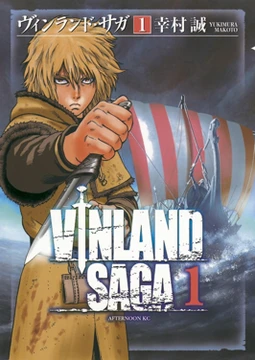
Thorfinn
From a boy seeking blood to a man building peace, Thorfinn walks the hardest road to find Vinland.

Thorfinn is the central protagonist of Vinland Saga, a young Norse warrior whose life is defined by an insatiable thirst for vengeance and a subsequent journey toward redemption. Initially introduced as a hot-headed swordsman driven solely by the desire to kill Askeladd, the man responsible for his father's death, Thorfinn evolves from a weapon of violence into a pacifist seeking a land without slavery or war.
- Origin
- Iceland
Lore & Background
After Askeladd was killed by Canute, Thorfinn lost his purpose and was sold into slavery on Ketil's farm in Iceland. This brutal period stripped him of his warrior identity, forcing him to endure physical labor and abuse without retaliation. It was here that he began to understand the true cost of violence and the meaning of a real life, eventually finding a new path as a farmer who refuses to fight, embodying the ideals his father once spoke of.
In Their Own Story
The sun dips low over the frozen fields of Ketil's farm, casting long shadows across the snow. Thorfinn stands alone in the paddock, his hands rough and red from shoveling manure. A younger boy approaches, eyes wide with fear as a group of drunk men stumbles toward them, weapons drawn. The old instinct flares—a spark to draw steel, to end the threat before it begins—but Thorfinn closes his fist around the shovel handle instead of a sword hilt. He looks at the terrified child and then at the approaching danger, realizing that true strength lies not in how many enemies he can cut down, but in how much pain he can endure without breaking.
Reader's Guide
Thorfinn begins as a tragic figure consumed by rage, believing his only value is his ability to kill. His arc is a deconstruction of the warrior myth, showing that violence begets only more suffering. In the early chapters, he possesses supernatural swordsmanship, capable of defeating seasoned veterans despite his youth. However, this skill is portrayed as a curse rather than a gift, isolating him from others and binding him to a cycle of revenge. His defining moment occurs when he finally kills Askeladd, only to realize the victory brings no joy. This leads to his enslavement, where he learns that a life without fighting is possible. He eventually becomes a symbol of non-violence, protecting others through endurance and labor rather than steel.
Did You Know?
- Thorfinn's name means 'Thor's peace,' which serves as a heavy irony given his initial violent nature before he truly understands its meaning.
- During his time as a slave, he deliberately avoids using his sword skills to survive, choosing to suffer abuse rather than kill his tormentors.
- He is one of the few characters who survives into adulthood without losing an eye or limb, symbolizing his physical survival despite spiritual trauma.
Origins and Historical Inspiration
Makoto Yukimura crafted Thorfinn as a fictional protagonist loosely inspired by the historical Icelandic explorer Thorfinn Karlsefni. While the real figure accompanied Leif Eriksson to Vinland, historical records offer scant details, granting the author significant creative liberty to reshape the narrative. Yukimura initially conceived the character as a slave but shifted him to a Viking warrior at his editor's suggestion, aiming to explore the tragedy of violence more deeply. The fictional Thorfinn diverges sharply from history, evolving from a brutal soldier committing heinous acts into a figure seeking redemption and understanding. This transformation was influenced by Yukimura's admiration for Kenshiro from Fist of the North Star, though the author sought to create a hero capable of changing society rather than just fighting chaos. The character's birthday, February 3, is entirely fictional since the historical explorer's birth date remains unknown. Ultimately, Thorfinn serves as a vessel to examine how a person fated for violence might eventually embrace peace.
The Path of Revenge and Violence
Introduced as a teenage warrior within Askeladd's Viking company, young Thorfinn is driven by an all-consuming hatred for his commander, who murdered his father, Thors. His sole purpose becomes killing Askeladd in a duel, a goal that forces him to commit sabotage and assassinate enemy generals to earn the right to fight. During this era, Thorfinn relinquishes his humanity to rage, symbolized by carrying his late father's dagger as a memento of his transformation. Yukimura designed this arc with little humor, emphasizing the character's corruption and loss of innocence. The narrative highlights how Thors' teachings about avoiding enemies were ignored in favor of a competitive, violent worldview. As Thorfinn executes difficult tasks for Askeladd, he becomes a tool of destruction, embodying the toxic masculinity that the story later seeks to deconstruct. This period establishes his identity as a warrior defined by bloodshed rather than the adventurous spirit he once possessed.
Redemption and Philosophical Growth
After over a decade of Viking life, adult Thorfinn begins to question his actions, shifting from a revenge-driven killer to someone seeking a land without violence. This profound evolution is heavily influenced by King Olaf Tryggvason and the character's time living as a slave, which critics praised for adding significant depth to his persona. The story explores how he rejects toxic masculinity to become a positive model, moving away from the savage warrior of his youth. Yukimura intentionally altered Thorfinn's design, having him shave his beard in the second arc to visually represent weakness rather than strength. This phase focuses on understanding others and redeeming past sins, contrasting sharply with his earlier desire for combat. The narrative examines the effects of revenge on both the avenger and those around them, particularly through complex relationships like the one with Einar, where mutual aid is hindered by dark circumstances.
Critical Reception and Cultural Impact
Initial critical responses to Thorfinn were mixed; while his tragic backstory and loss of innocence resonated, some critics found his early rude demeanor off-putting. However, his fight scenes received widespread praise, and the character's growth across different story arcs was celebrated for providing necessary depth. Scholars have analyzed Thorfinn as a case study in rejecting toxic masculinity, noting how the brutal man evolves into a caring individual. The anime adaptation further highlighted this journey through multiple voice actors portraying both his child and adult personas, with performances that garnered acclaim. Yukimura noted that the relationship between Thorfinn and Askeladd was executed well, functioning as a complex father-son dynamic where Askeladd serves as both mentor and enemy. Ultimately, Thorfinn's portrayal has been recognized for its entertainment value and emotional weight, particularly in how it handles themes of savagery remaining after major conflicts.
Frequently Asked Questions
Who is Thorfinn?
Thorfinn is the central protagonist of Vinland Saga, an Icelandic warrior whose life begins as a quest for vengeance against Askeladd. Over time, he transforms from a bloodthirsty swordsman into a pacifist dedicated to creating a peaceful society.
What drives Thorfinn's early actions?
Initially, his sole motivation is to kill Askeladd in revenge for the murder of his father, Thors. This obsession turns him into a ruthless weapon used by various warlords until his worldview shatters.
How does Thorfinn change throughout the story?
After losing his reason for fighting and enduring years as a slave, he abandons violence entirely to pursue a life of farming and non-violence. His journey shifts from seeking death to building a future where no one needs to be enslaved.
What is Thorfinn's ultimate goal?
He seeks to find Vinland, a legendary land without slavery, war, or the need for swords. This dream represents his commitment to breaking the cycle of violence that has plagued his life since childhood.
Is Thorfinn still alive at the end of the series?
Yes, Thorfinn remains alive as he continues his journey toward establishing a peaceful settlement. He actively works with former enemies and allies alike to realize his vision of a utopia free from conflict.